
St. Joseph Mosaic:
Love & Devotion of a Father
by Kevin Pawlowski, Paradise Found Studio
When art serves a sacred space, it becomes more than just paint or glass. It becomes a bridge between the physical and the spiritual.
Recently, I had the honor of completing a major project for Transfiguration Catholic Church in Marietta, Georgia. As the artist behind Paradise Found Studio, my mission has always been to create sacred art that draws viewers into deeper contemplation. This project (a large stained glass mosaic of St. Joseph) was a deeply personal journey, combining timeless theology, thoughtful design, and a raw human connection.
Here is the story behind the St. Joseph mosaic: the inspiration, the theological symbolism, and the detailed process of bringing him to life.
Project Overview: Transforming the Narthex
In late summer 2025, Father Eric, pastor of Transfiguration, approached me to collaborate with fellow artist Dale Mulnar on a transformative project. The church was renovating its entrance space into a true Narthex.
The architectural intent was powerful. The Narthex would act as a sacred threshold, preparing parishioners as they pass from the busy outside world into the sacred space of the sanctuary. To guide worshippers along this spiritual journey, the vision called for six original stained glass mosaics featuring:
Holy Mary
St. Joseph
The Four Gospel Writers (Matthew, Mark, Luke, and John)
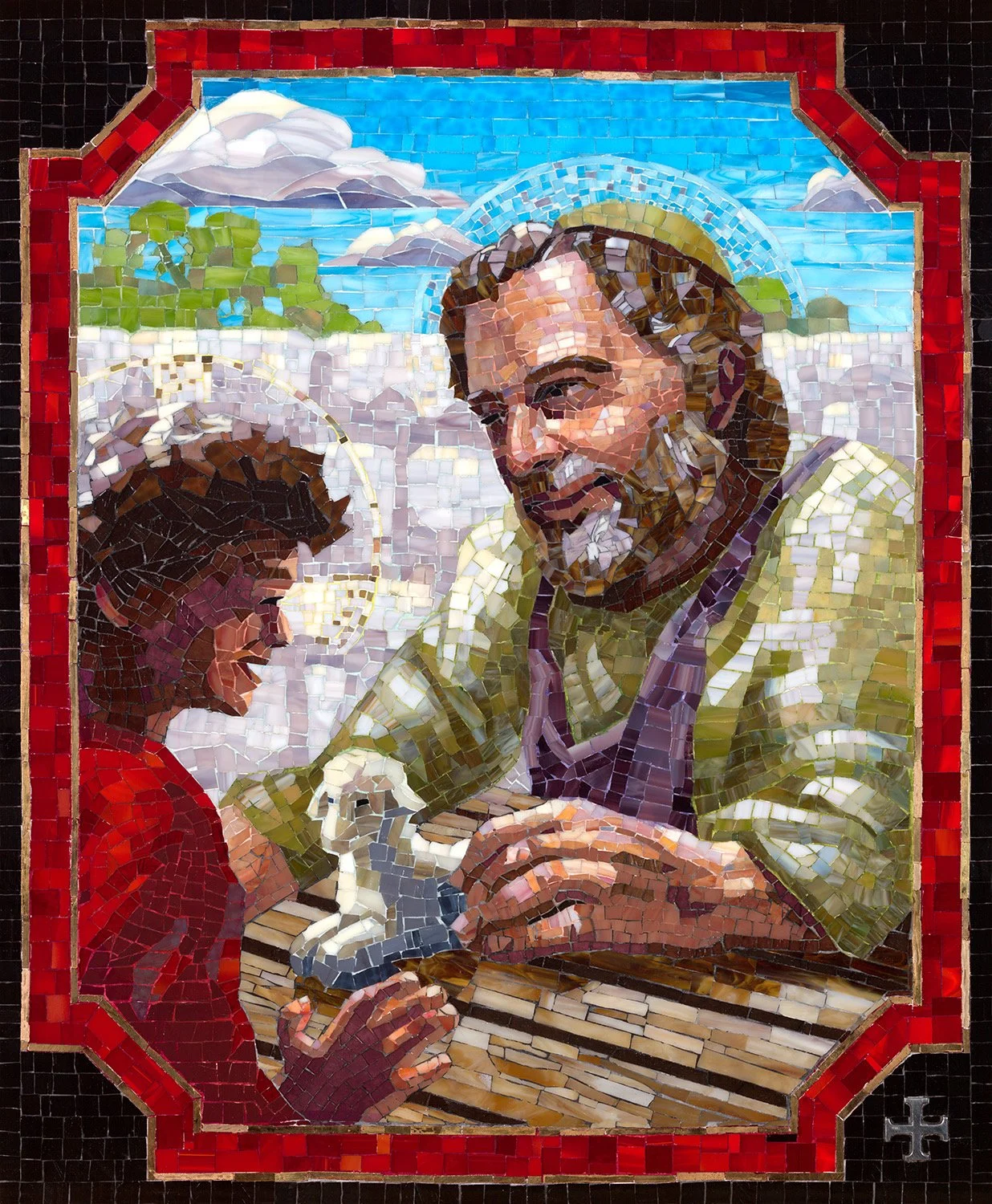
To unify the series, Dale conceived a consistent border design to act as a "window frame" into a sacred world. This was a direct nod to traditional Byzantine and Orthodox iconography. The portraits of Mary and Joseph feature rich, royal red borders, while the four evangelists are framed in deep celestial blue with stars.
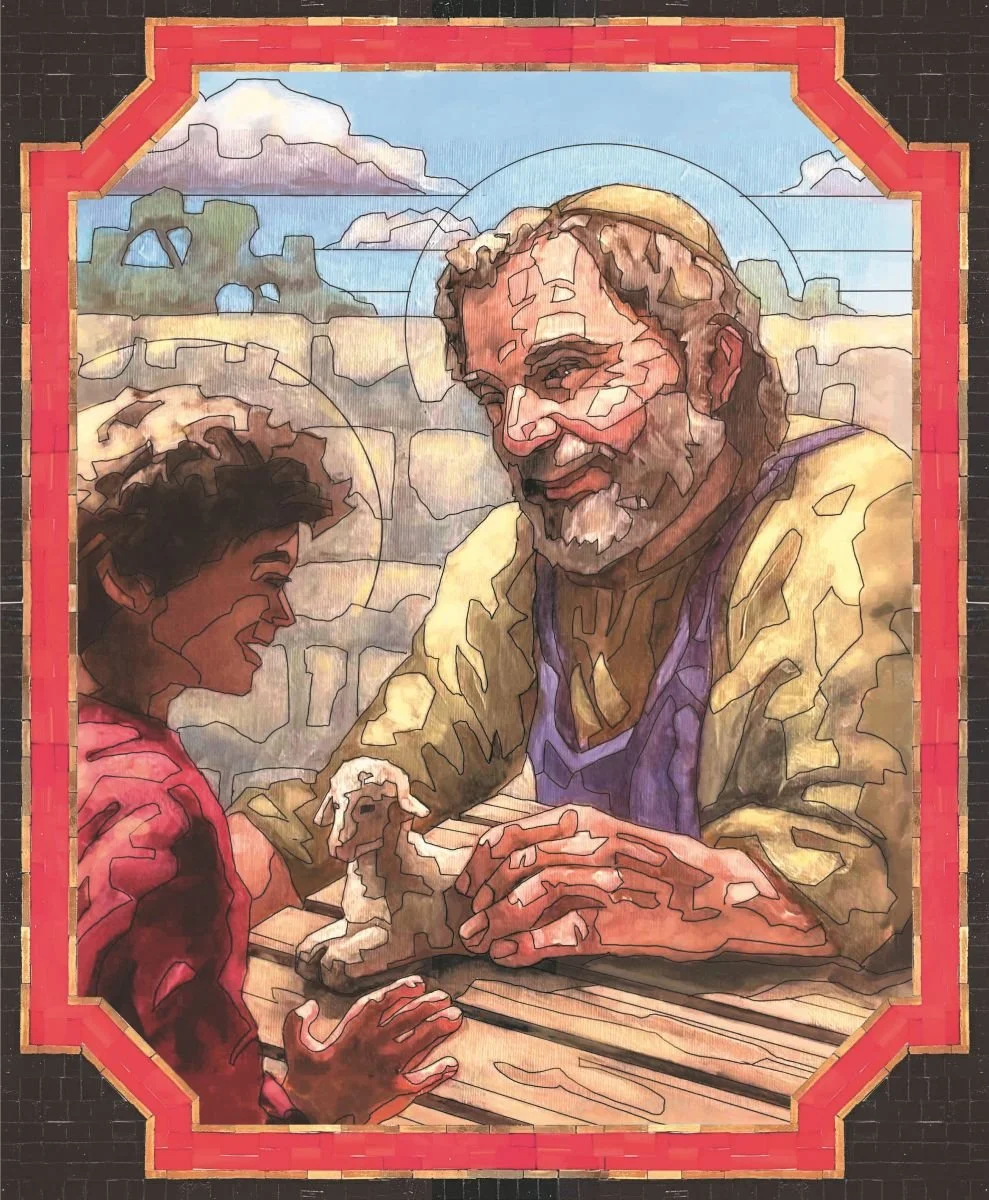
St. Joseph stained glass mosaic by Kevin Pawlowski (2026)
The Concept: Finding Personal & Theological Depth
When Dale and I sat down to divide up the six panels, we had to do a bit of good-natured "horse trading." Dale felt a strong calling toward creating Holy Mary and the Annunciation scene. For me, the choice was immediate. Having lost my father the prior year, I felt drawn to exploring St. Joseph’s identity, specifically his tender, earthly relationship with the young Christ.
Reimagining the Foster Father of Christ
Traditionally, artistic depictions of St. Joseph tend to follow a few specific visual traditions:
The Elderly Guardian: Historically, he is often depicted as a much older man (middle-aged or elderly) with white hair and a beard.
The Slender Artisan: Renaissance masters frequently painted him as tall, lean, and gentle.
Classic Attributes: He is routinely shown holding a lily-flowering staff (symbolizing purity and his selection as Mary's spouse) or holding his hand over his heart in quiet obedience.
I wanted to honor tradition while depicting Joseph through a fresh, grounded lens. I chose to portray him in his late 40s or early 50s, standing in front of a 6- or 7-year-old Jesus.
Because Joseph was a tekton (a carpenter and likely a stone mason, given the arid landscape and scarcity of large timber in ancient Israel), he wouldn't have been frail. I depicted him with broad shoulders, thick arms, and large, weathered hands shaped by decades of hard labor. Yet, those same rough hands hold the young Christ with profound gentleness.
The Symbolic Palette
Every garment and detail in the mosaic carries intention:
Earthy Green Tunics: Represents Joseph's humble, grounded life as a daily worker.
The Yarmulke: A subtle reminder of his Jewish faith and heritage.
The Royal Purple Apron: While an apron signifies his trade, the purple hue honors his direct lineage from the royal house of King David.
Jesus in Crimson Red: Represents Christ’s high royalty and divinity, while subtly foreshadowing the sacrifice of the Passion.
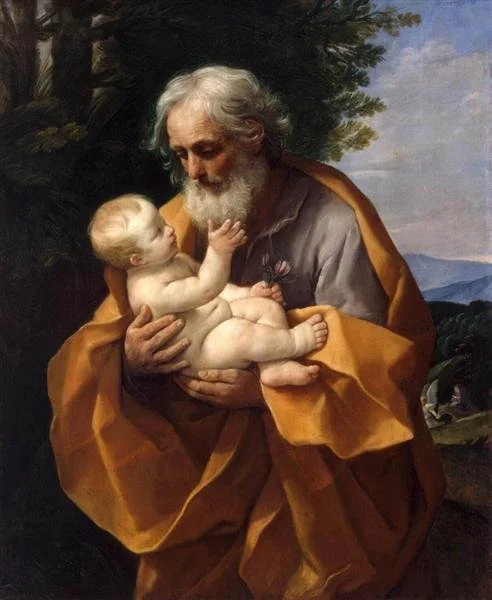
St Joseph with the Infant Jesus by Guido Reni (1620)
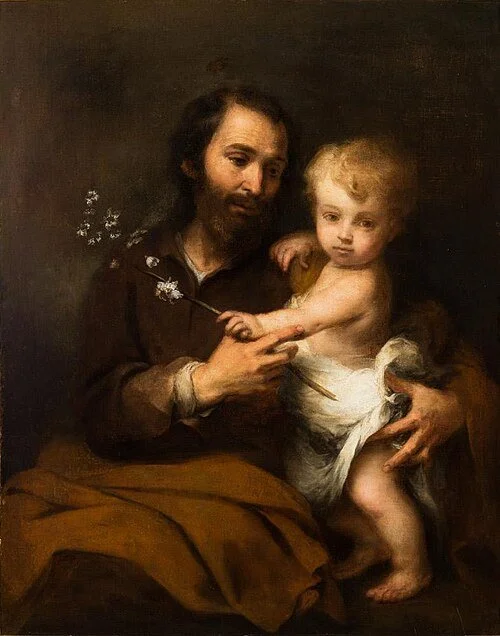
St Joseph with the Christ Child by Bartolomé Esteban Murillo (1670-75)
Deepening the Narrative: The Carved Lamb
In the mosaic, Joseph is shown gently presenting a hand-carved wooden toy lamb to young Jesus. It is a sweet, intimate moment between father and son, but it invites profound theological reflection.
We know theology names Jesus as the sacrificial Lamb of God. But standing in that workshop two thousand years ago, what did Joseph know? How much had the Angel Gabriel revealed to him and Mary? Did Joseph recognize the prophetic weight of presenting a lamb to his foster son, or was he simply giving a cherished handmade toy to the boy he loved?
This quiet ambiguity is the heart of the mosaic: a moment for parishioners to stop, reflect, and ponder as they walk into Mass.
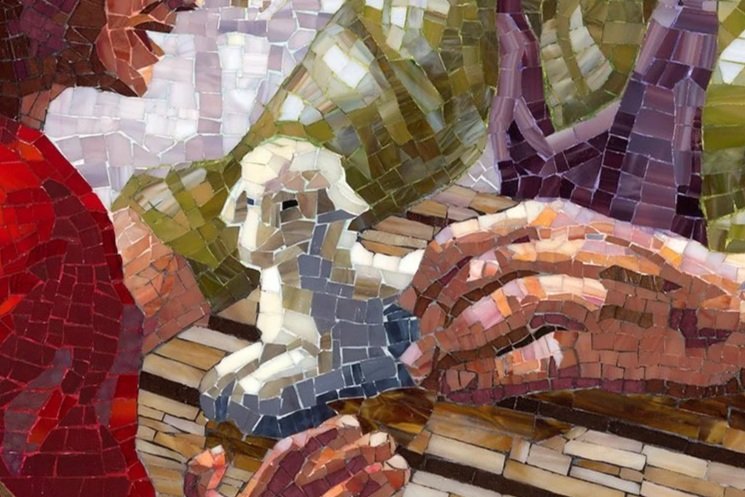
Detail of carved lamb in St. Joseph mosaic.
Step-by-Step: The Mosaic Process
Creating a stained glass mosaic is a meticulous, highly tactile process that bridges medieval craftsmanship with modern technique.
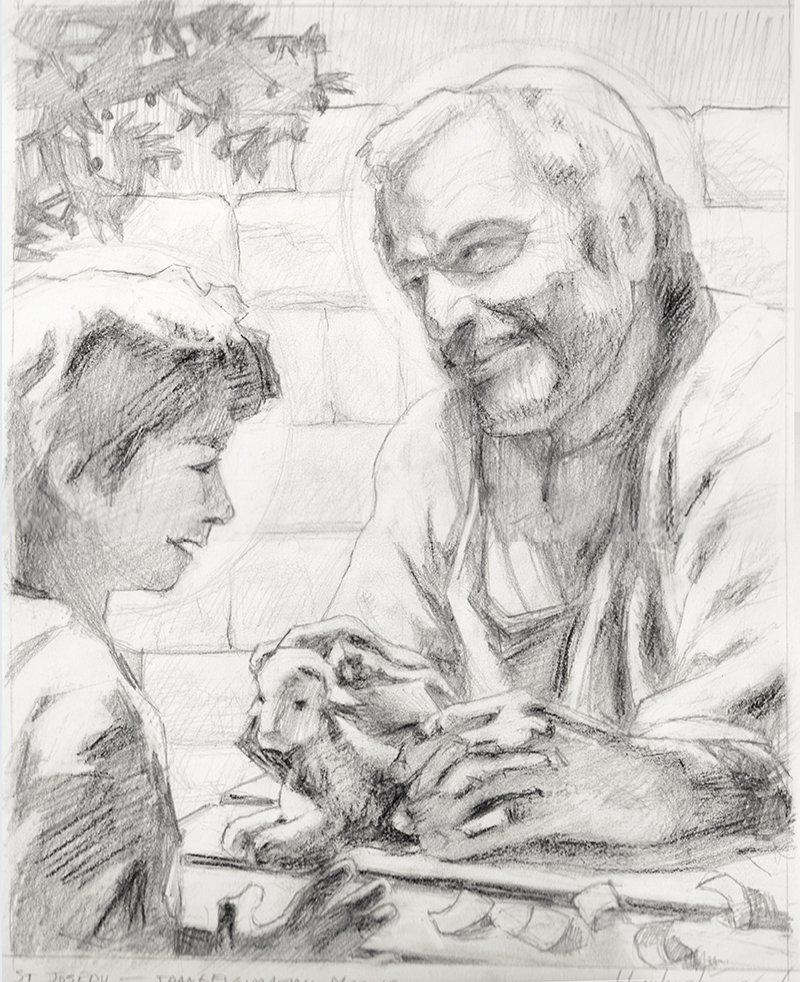
Concept Drawing
I start with a graphite and charcoal drawing of the concept. I might work from my imagination, pull digital references, or even live models. It isn’t unusual for me to patch together a variety of reference materials in Photoshop.
For the most part, the concept was pretty much fully formed at this stage. I presented it to Fr. Eric for his approval to move forward. I try to give my clients a full picture of the direciton before taking it too far.
Painting Sketch
The next step is a quick painting sketch to nail down the composition and color pallet. Planning the pallet for mosaics is particularly important because I have the search for and acquire glass for all the colors. Unlike painting, with mosaics I can’t just open a tube and create whatever color I need.
Since I’m primary a painter (specializing in oils), my conceptualization process tends to revolve around that medium. This is probably very different from the processes of Dale and other mosaic artists, but then again, artists tent to refine whatever creative steps are comfortable and successful for them.
For this first mosaic, I was a little too subdued with the color. I decided later to increase the saturation to take full advantage of the beauty of stained glass.
Note that I also simplied the composition by deleting the wood shavings, and pushing the tree behind the wall. I also moved Joseph’s right hand from sanding the lamb to reaching out to Jesus. That helped clean up the silhouette of the lamb, making it more readable, and increasing the inimacy of the pose.

Cartoon Template
This step is probably very unique to my process, since I have a long history of working with digital graphic tools. On an iPad, I overlayed the drawing over the painting, and then traced and redrew to make what is called a “cartoon”. While I don’t plan out the placement of every tessera (glass piece), this gives me the general layout of the various colors.
Once again, I paused and set a meetiing with Fr. Eric to get his approval.
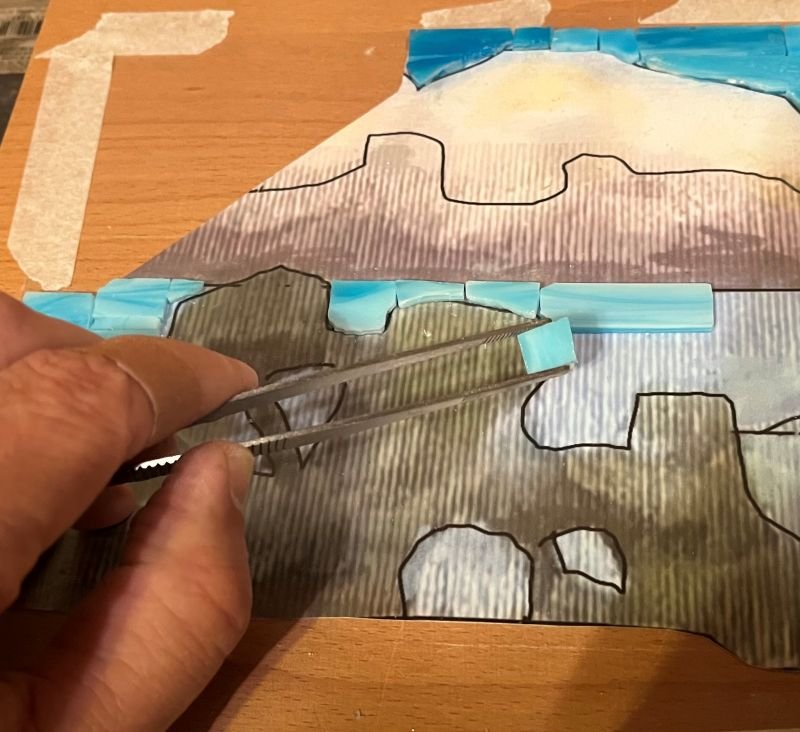
Stained glass cut and stuck on adhesive contact paper over the cartoon template.
Mosaic Assembly
The cartoon was printed full-scale, cut apart to managable sections, and used as a template for the assembly process. Clear Contact Paper was taped over the template, sticky side up. Then glass tesserae were cut and ground to the sizes an shapes needed, and placed over the template.
Once a section was completed, and even sticker material (sort of like shipping tape) was applied over the mosaic section, and transfered to the final concrete board base. Those sections were then permanently glued in place.
Grouting & Final Finishing
After setting the glass, a llight gray grout was worked into every seam, locking the thousands of glass pieces into a single, permanent panel. This process is very similar to how tile is installed for a shower wall.
As a final step, I paint the grout lines with colored ink to visually group colored sections and make the image more conhesive.
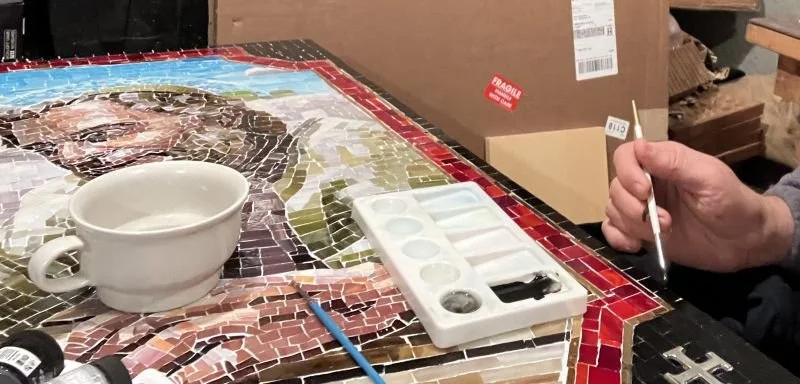
Colored ink is applied to the grout lines.
Art in a church setting isn't just decoration… it is a visual sermon.
My hope is that as the community of Transfiguration Catholic Church walks past St. Joseph in the new Narthex, they see a protector who is strong yet tender, earthly yet connected to the divine, and perhaps find a bit of their own spiritual journey reflected in his story.
To request a proposal for a commission for your own project, go to my commission contact page.
Buy Reproductions of Mosaics & Work-in-Progress Images
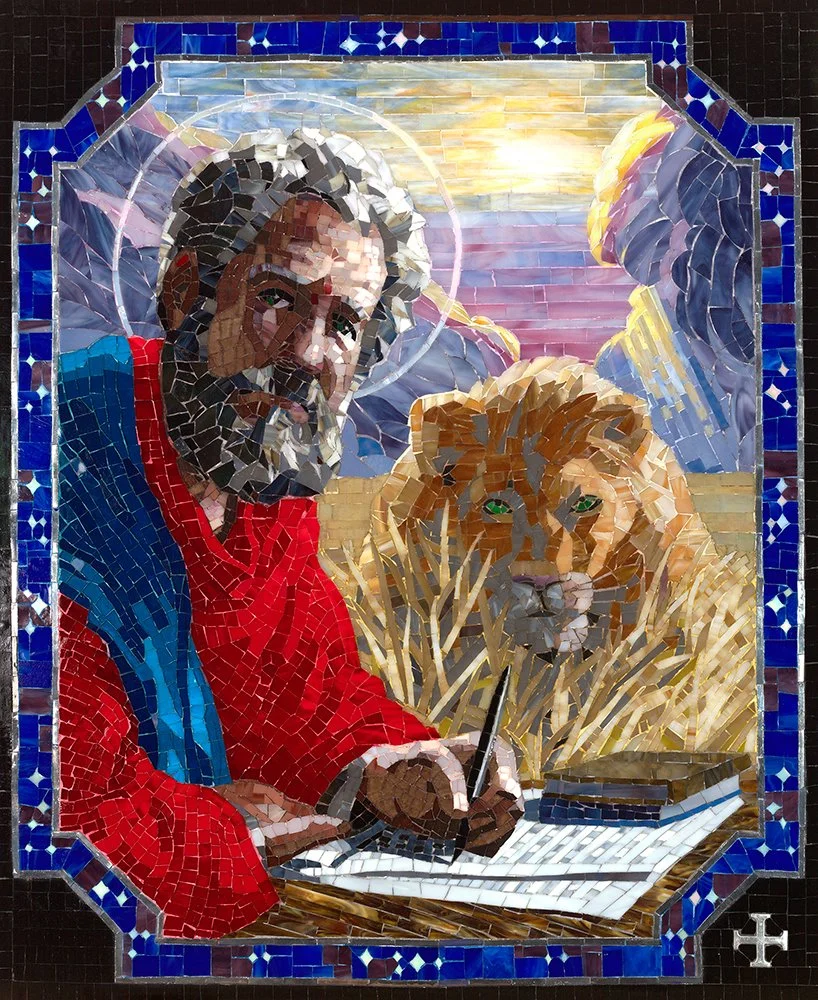
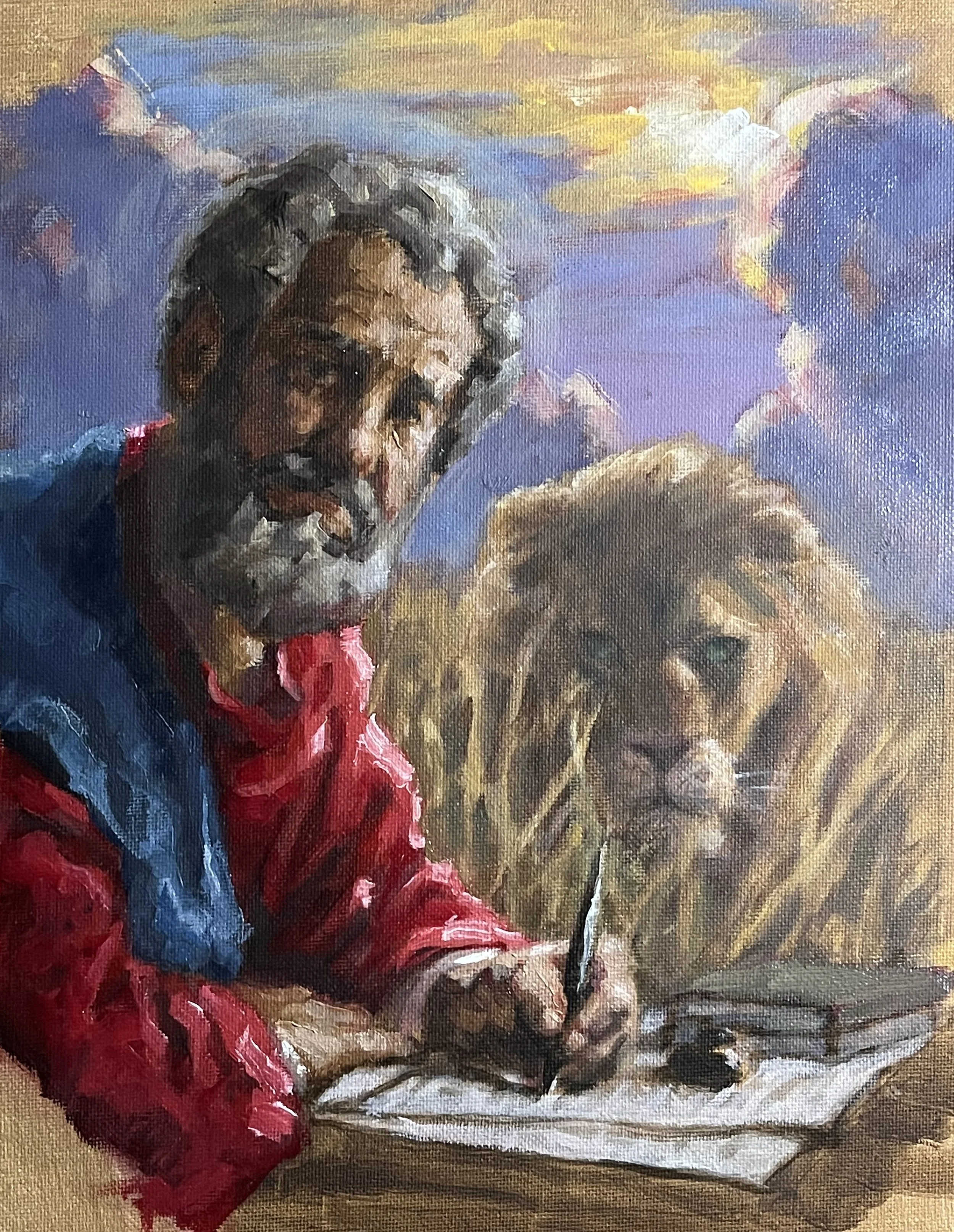

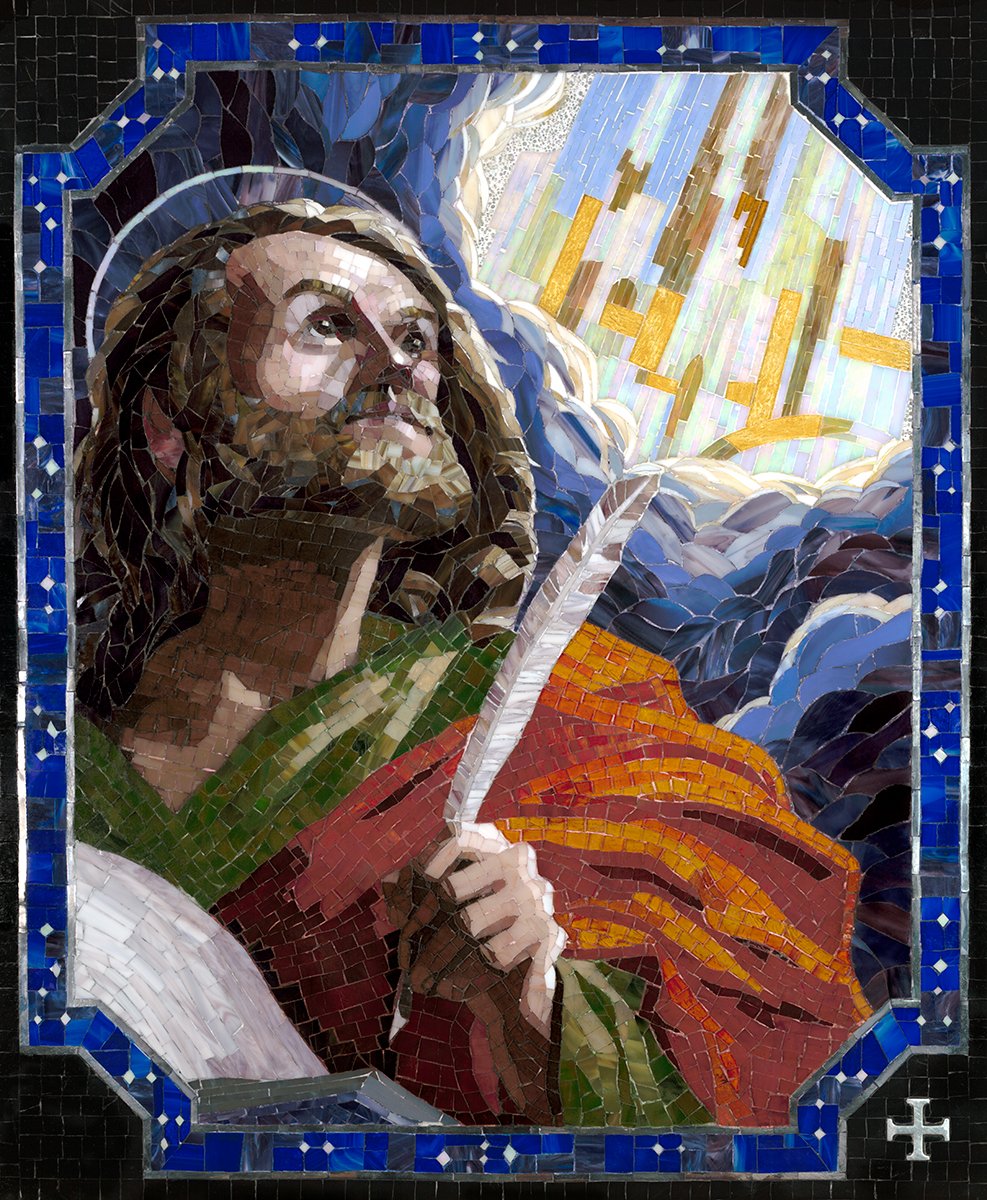
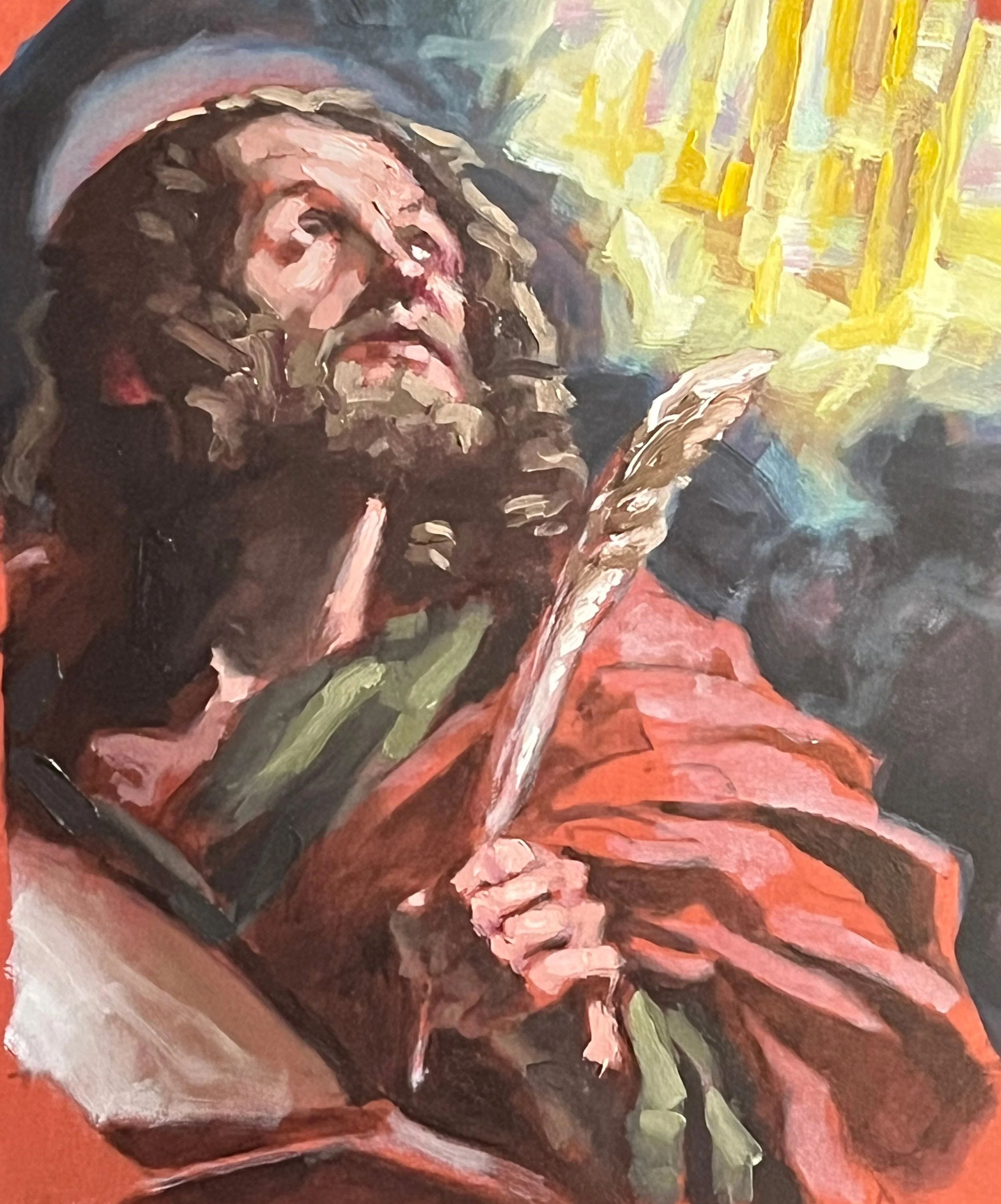
Be a part of the Transfiguration renovation project and hang art reproductions in your own home! Kevin Pawlowski is offering reproductions of his sketches, color studies, and final mosaics as they become available.
All reproductions are printed using the highest quality Giclée method, which ensures they look as close to the originals as possible. Drawings are reproduced on cotton uncoated paper, similar to watercolor paper, and color studies are printed on stretched canvas.
All profits will be donated to the Transfiguration narthex renovation project.
Background on Transfiguration Mosaic Project
Transfiguration has commissioned artists Dale Mulnar of Southlight Studio, and Kevin Pawlowski of Paradise Found Studio to create 6 original mosaic images of for the renovated narthex:
St. Mary - by Dale
An image of the Annunciation, the announcement of the Incarnation by the angel Gabriel to Mary.St. Joseph - by Kevin
An intimate scene of St. Joseph and a young Jesus.St. Matthew - by Dale
St. Matthew throwing down his worldly treasure to follow Christ.St. Mark - by Kevin
St. Mark with an image of a lion, the traditional symbol associated with Mark.St. Luke - by Dale
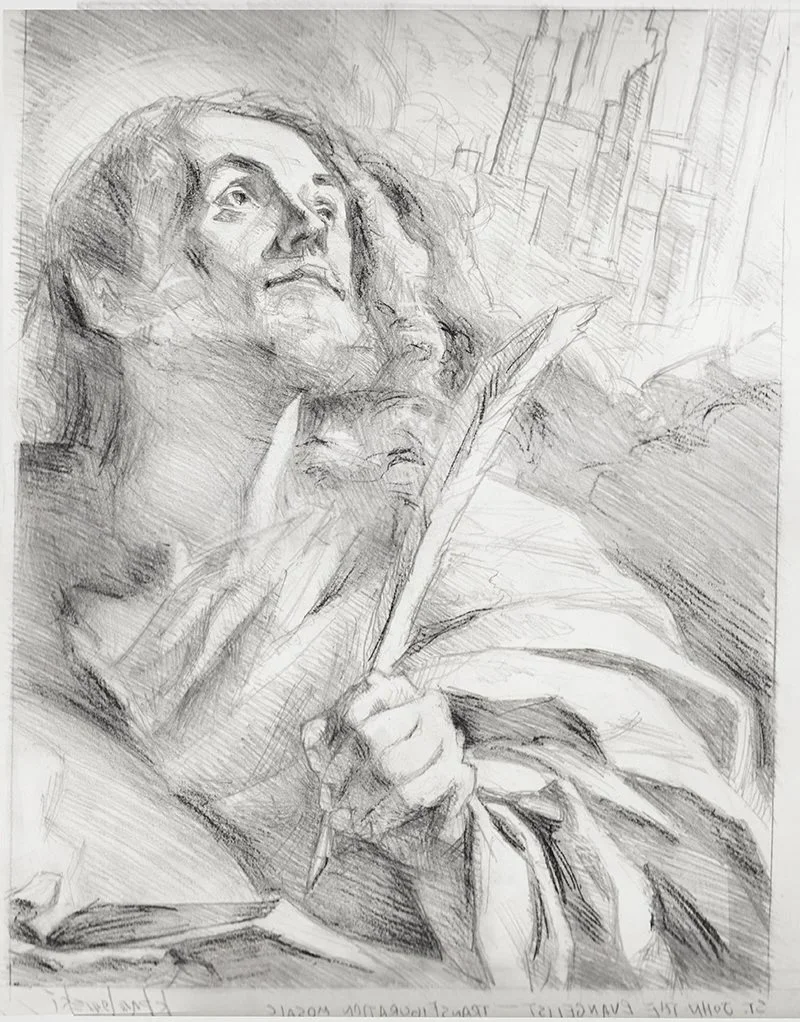
St. Luke is hard at work writing his Gospel.St. John - by Kevin
St. John gazing at a vision of New Jeruselum, as referenced in Revelation 21.
The mosaics are expected to be finished in stages, the first few late 2025, and the rest through mid-2026.
Please feel free to contact me with any questions.