
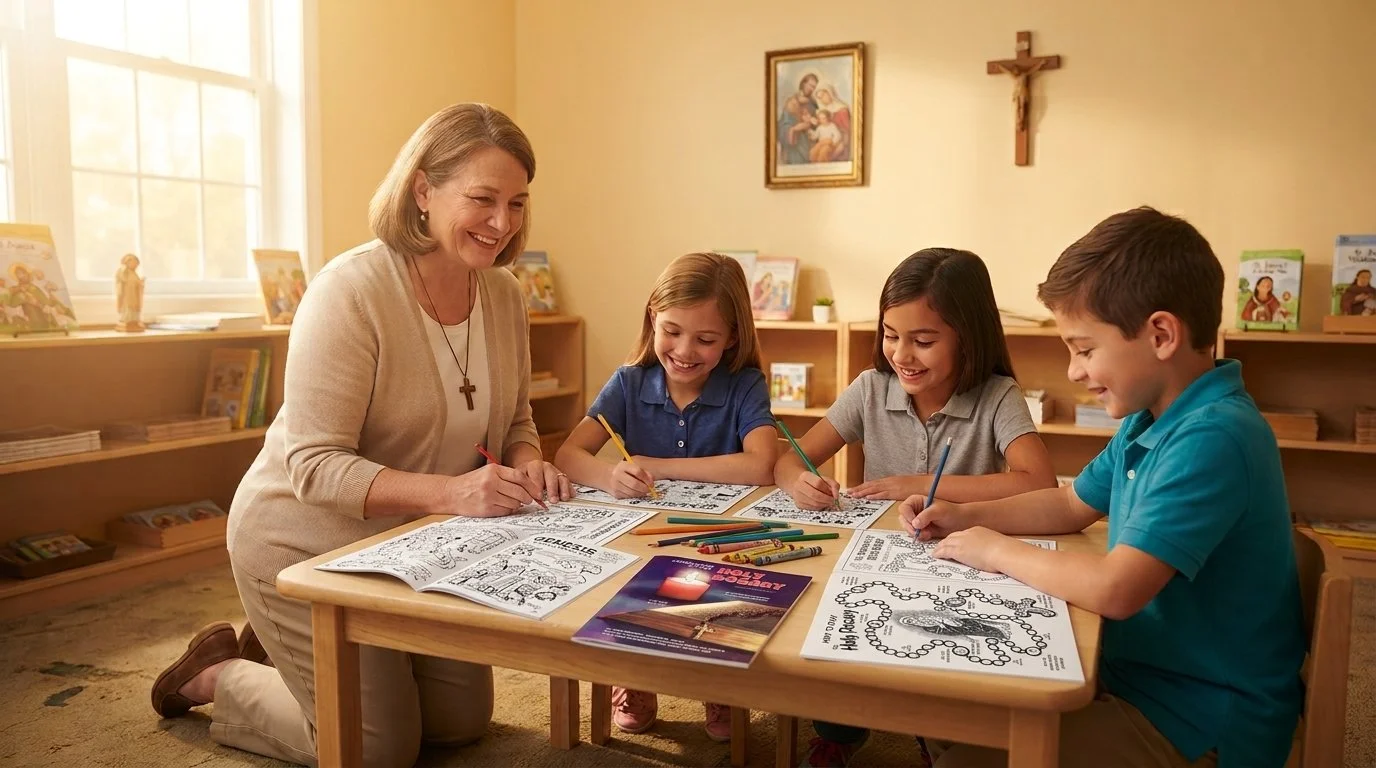
Serving as a parish catechist or Catholic school religion teacher is one of the most rewarding roles in the Church. Every week, dedicated volunteers and educators step into classrooms with the goal of passing down centuries of sacred tradition, scripture, and prayer to the next generation. Yet anyone who has spent twenty minutes in a room full of energetic third graders knows that good intentions alone do not hold young attention spans.
Even the most well-organized religious education programs can fall into teaching habits that unintentionally make the faith feel dry, confusing, or disconnected from daily life. When children struggle to engage during class, the issue is rarely a lack of curiosity about God. More often, it comes down to how the material is presented.
Drawing on over a dozen years of classroom catechism experience, fine artist and educator Kevin Pawlowski created a line of visual, hands-on teaching resources at Paradise Found Studio specifically designed to solve these classroom hurdles. Below are five of the most common mistakes catechist programs make when teaching young children, along with practical ways to turn your classroom around.
1. Relying Too Heavily on Lectures and Dense Textbooks
Children learn by seeing, touching, and doing, not by sitting through forty-five minutes of passive lecture. Many parish programs lean heavily on standard workbooks filled with walls of text and abstract theological vocabulary. When a young student is asked to sit still and simply listen to explanations of grace, sacraments, or Church history, their minds quickly wander.
How to fix it: Break up verbal instruction with visual storytelling. Sequential art and comic-style illustrations naturally capture a child's imagination while making complex ideas easy to follow. Instead of only reading about the lives of the saints aloud, hand out illustrated saint comics featuring figures like St. Joan of Arc, St. Francis of Assisi, or St. Padre Pio so students can see the drama and courage of their stories unfold panel by panel.
2. Asking Kids to Memorize Prayers Without Context
Teaching children to recite the Our Father, the Hail Mary, or the Apostles' Creed is essential, but rote memorization without understanding turns prayer into a mechanical chore. When kids do not know what the words mean or where a prayer came from, they struggle to pray from the heart.
How to fix it: Pair prayer memorization with visual explanations that connect the words to scripture and salvation history. Illustrated prayer comics allow students to slow down and examine each line of foundational prayers like the Glory Be, the Hail Holy Queen, and the Nicene Creed while coloring the imagery. When children understand the story behind the words, prayer becomes a real conversation with God rather than a tongue twister to rush through.
3. Treating the Rosary as Too Complex for Younger Grades
Many catechists hesitate to introduce the full Rosary to elementary-aged students because they worry the sequence of prayers and twenty mysteries will overwhelm them. As a result, the Rosary is often reduced to a single decade rushed at the end of class, leaving kids unsure of how the devotion actually works.
How to fix it: Give students a tactile, step-by-step visual guide they can actively interact with. The Comic Guide to the Holy Rosary, available through Paradise Found Studio, transforms the devotion into a 36-page color-along activity book. Children color each bead as they pray, read comic stories about the history of the Rosary, and reflect on illustrated Bible passages for the Joyful, Sorrowful, Luminous, and Glorious Mysteries. Breaking the guide into fifteen-minute weekly segments lets students master the Rosary at a comfortable, joyful pace.
4. Skipping Hands-On Activities That Reinforce the Lesson
Children retain far more information when their hands are engaged alongside their minds. Programs that treat crafts and activities as mere "time fillers" miss a valuable opportunity to cement core Catholic teachings in a child's memory.
How to fix it: Use purposeful, faith-centered activities that require active problem-solving and participation. Printable resources like a Beatitudes Cootie Catcher, a Moses and Exodus Maze, or a Family Tree of Jesus Scrapbook Activity turn abstract lessons into memorable experiences. When students fold, trace, cut, and color their way through a lesson, they take ownership of what they have learned and proudly bring those materials home to share with their families.
5. Forgetting to Equip Parents for Faith at Home
A single hour of religious education each week cannot compete with the rest of a child's schedule unless parents are brought into the loop. Too often, classroom materials stay in the parish building, leaving families without simple, engaging tools to reinforce Sunday lessons during the week.
How to fix it: Send students home with completed comic pages, prayer guides, and interactive activities that naturally spark dinner-table conversations. Because printable downloads can be reproduced for your entire class throughout the school year, catechists can easily send extra copies home so younger siblings and parents can color and pray together.
Bring Your Catechism Classroom to Life
Teaching the Catholic faith to young minds should be an inspiring experience for both the teacher and the student. By replacing passive lectures with vibrant visual storytelling and tactile activities, you can help children build a lifelong love for scripture, prayer, and the saints.
Explore the full collection of printable prayer comics, saint stories, classroom activities, and the Comic Guide to the Holy Rosary today at www.paradisefoundstudio.com to equip your parish program for a joyful year of faith formation.